
To encourage taxpayers to continue charitable giving after World War I, Congress enacted the first laws permitting tax deductions for donating to worthy organizations. Since then, charitable contributions have become a vital tax planning tool and have helped millions of taxpayers lower their taxes while giving back to their communities.
Starting in 2026, charitable contribution deductions will feature three major changes that will likely affect most taxpayers and their short-term and long-term tax plans.
2026 New Rules for Charitable Contributions
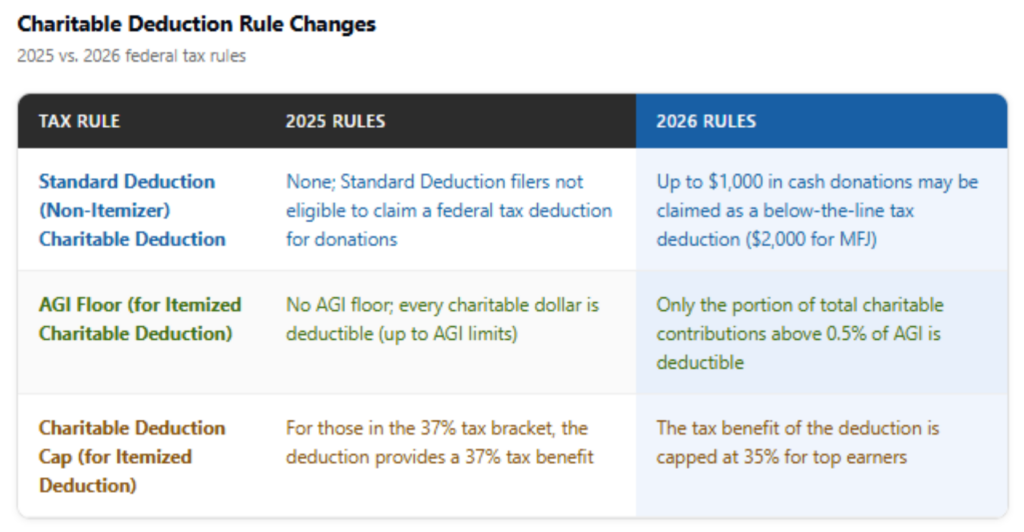
There are three main adjustments to charitable contribution deduction rules starting in 2026:
1. Standard Deduction (Non-Itemizer) Charitable Deduction
One of the most significant changes addresses the main limitation of the prior charitable contribution rules: it only benefits taxpayers who itemize their deductions. Starting in 2026, taxpayers who use the standard deduction can deduct up to $1,000 ($2,000 MFJ) of eligible charitable contributions. This permanent non-itemized deduction only applies to cash contributions and is not eligible for carryforward. Donations made through a donor-advised fund (DAF) or to a private foundation are not eligible for this deduction.
2. The AGI Floor (Itemized Deductions only)
For the first time ever, charitable contribution deductions will be subject to an AGI floor (of .05%). This means the deductible amount is the total contribution that exceeds .5% of a taxpayer’s adjusted gross income.
For example, if a taxpayer’s AGI is $100,000 and they donated $4,000 throughout the year, their AGI floor is $500, resulting in a $3,500 ($4,000 – $500) charitable contribution deduction.
Note: The AGI Floor rule applies to prior-year carryforward amounts being used in 2026.
3. Deduction Cap for High-Income Donors (Itemized Deductions only)
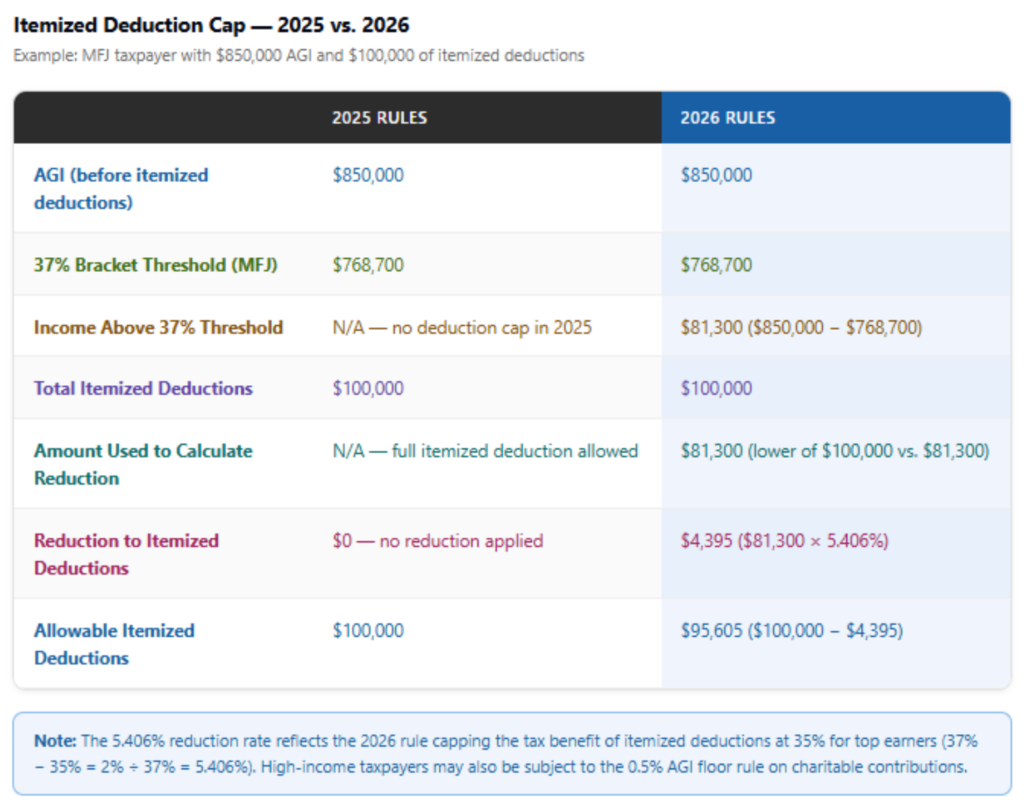
In addition to the new AGI floor, charitable contribution deductions could be further limited for high-income donors within the top tax bracket (37%). This updated rule imposes a 35% maximum tax benefit on the total itemized deductions for high earners. Unlike the other tax changes, this rule affects the itemized deductions in total and not just charitable contributions.
Simply put, for taxpayers in the highest tax bracket, itemized deductions will be reduced by 2/37 (5.406%) of the lesser of:
- Total itemized deductions, or
- The applicable income above the top-bracket threshold.
What Has Not Changed?
In good news, there are many charitable deduction rules that have not changed.
- The 20%, 30%, and 50% AGI percentage limits for property and private-foundation gifts.
- The 60% AGI percentage limit stays unchanged, but it is now permanent (was set to expire after 2025).
- The 5-year carryforward, which allows any unused charitable contributions (limited by the AGI percentage) to be taken up to five tax years after.
- Long-term donated appreciated property (held more than one year) deduction valued at fair market value with no gain recognized.
- Short-term donated property and ordinary income deduction are valued at the lesser of the basis or the fair market value.
- Exclusion of Qualified Charitable Distribution (QCD) income as a charitable deduction.
Quick Recap
With these three recent changes to charitable deductions, taxpayers may need to change their tax-saving strategy starting this year. Creating a solid tax plan each year is vital to maximizing your tax bracket and identifying tax opportunities.
Having a designated tax planning professional in your corner can help immensely. If you need help with your tax plan, contact us today. Our tax planning team will be happy to work with you!