

Unlike retirement accounts, brokerage accounts are taxable, so it’s important to understand the tax implications before selling investments or withdrawing funds. Depending on what you sell and when you sell it, your tax bill can vary significantly.
Here are a few key considerations before taking a distribution from a brokerage account.
Understand Short-Term vs. Long-Term Capital Gains
One of the biggest factors that determines how your investment sale is taxed is how long you’ve owned the investment.
- Short-term capital gains apply to investments held for one year or less. These gains are taxed at your ordinary income tax rate, which is generally higher.
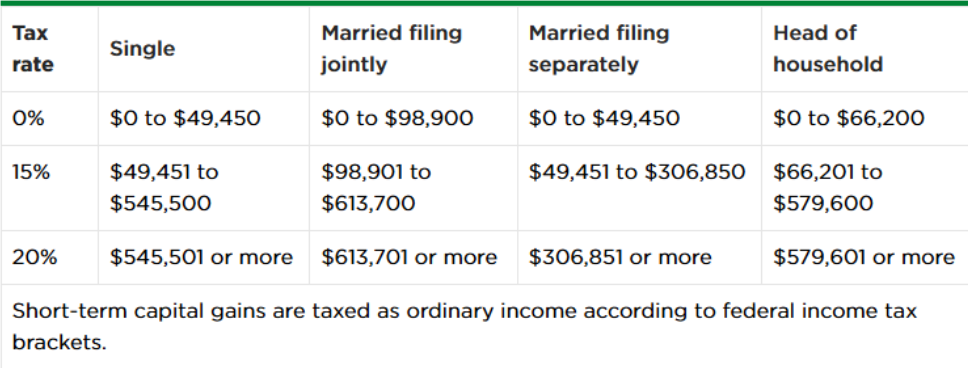
- Long-term capital gains apply to investments held for more than one year. These gains benefit from preferential tax rates of 0%, 15%, or 20%, depending on your taxable income.
Because of these lower tax rates, holding investments for more than one year before selling can often result in meaningful tax savings.
Inherited Brokerage Accounts Receive a Step-Up in Basis
If you inherit a brokerage account, you may receive valuable tax benefits.
In most cases, inherited investments receive a step-up in cost basis, meaning the cost basis is adjusted to the fair market value of the investments on the original owner’s date of death.
This can significantly reduce the taxable gain if the investments have appreciated substantially over many years.
For example:
- An investment purchased for $20,000 that is worth $100,000 at the owner’s death generally receives a new cost basis of $100,000.
- If you later sell it for $102,000, you would generally recognize only $2,000 of taxable gain rather than $82,000.
Another important advantage is that all gains or losses on inherited investments are automatically treated as long-term, regardless of how long the beneficiary actually owns the investment.
For example, if you inherit an investment in February and sell it in March of the same year, the gain or loss is still treated as long-term for tax purposes.
Consider Tax-Loss Harvesting
Before selling appreciated investments, it’s worth reviewing whether you have any investments currently trading at a loss.
Tax-loss harvesting is the strategy of realizing investment losses to offset realized capital gains during the same tax year.
The process generally involves:
- Selling investments that have declined in value.
- Using those realized losses to offset capital gains.
- If losses exceed gains, using up to $3,000 of remaining losses each year to offset ordinary income (with additional losses carried forward to future years).
Tax-loss harvesting can help reduce your overall tax liability while allowing you to reposition your portfolio.
Don’t Forget the Wash-Sale Rule
When harvesting losses, it’s important to understand the wash-sale rule.
A wash sale occurs if you sell an investment at a loss and purchase the same or a substantially identical investment within 30 days before or 30 days after the sale—effectively a 61-day window.
If a wash sale occurs:
- The loss is disallowed for current tax purposes.
- The disallowed loss is instead added to the cost basis of the replacement investment.
- The original holding period is carried over to the new investment.
Because of this rule, investors should carefully coordinate any purchases around the time they realize losses.
Final Thoughts on Withdrawing Money From a Brokerage Account
Brokerage accounts offer tremendous flexibility, but every sale can have tax consequences. Understanding capital gains rates, inherited cost basis rules, tax-loss harvesting opportunities, and the wash-sale rule can help you make more tax-efficient withdrawal decisions.
Before making large withdrawals or significant investment changes, it may be worthwhile to review your strategy with a tax or financial professional to ensure your decisions align with your broader financial plan.