

A Roth conversion can be one of the most powerful retirement tax-planning tools available, but it is not a “set it and forget it” decision. Done right, it’s a wealth-building strategy. Done without careful planning, it can easily cost more than it saves.
At its core, a Roth conversion means moving funds from a pre-tax retirement account, such as a traditional IRA or 401(k), into a Roth IRA. The appeal is significant: tax-free growth, tax-free qualified withdrawals, and no lifetime required minimum distributions.
So, what’s the catch? A conversion is a taxable event in the year it’s executed, and the tax bill is only one factor to consider. The right strategy depends on a moving set of variables: current and future income, tax brackets, market values, pensions, Social Security timing, Medicare premiums, estate goals, and even potential legislative changes. The tradeoff sounds simple: pay taxes now to potentially reduce taxes later, but in practice, the most effective strategies are rarely one-time events. They require careful modeling, thoughtful timing, and ongoing review.
Tax Bracket Management
The goal of a Roth conversion strategy is to use lower-income years to convert and pay taxes at lower marginal rates. This most commonly happens early in retirement, before Social Security and RMDs kick in. Other conversion windows include reduced hours, sabbaticals, or a business sale.
The size of the conversion matters as much as the timing. Convert too little, and a retiree may miss a valuable planning window. Convert too much, and they may push into a higher tax bracket, trigger Medicare surcharges, increase Social Security taxation, or create a larger tax bill than expected. The goal is to convert the right amount at the right time.
Cascading Effects on Other Taxes and Benefits
Poor bracket management can ripple across your entire financial plan:
- IRMAA Surcharges: Excess income can raise your Medicare Part B and D premiums by hundreds to thousands of dollars per year.
- Taxation of Social Security: Converting too much can trigger the “Social Security bubble,” increasing the taxable portion of your benefits.
- Net Investment Income Tax: An additional 3.8% tax may apply to your investment income in high-conversion years.
- Lost Credits and Deductions: Higher AGI can disqualify you from certain credits, deductions, or ACA subsidies.
- Capital Gains Rates: Poor conversion timing can push you into a higher bracket.
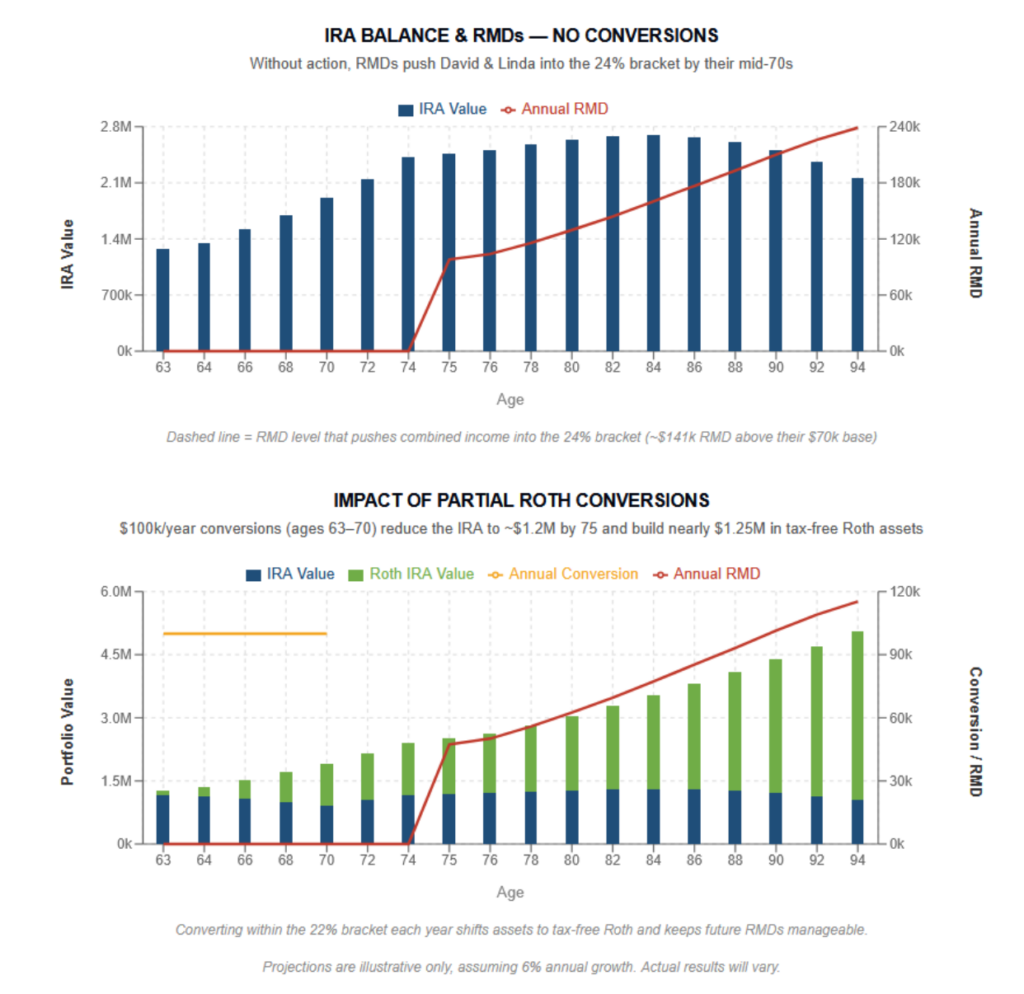
Example: David and Linda are both 63 and recently retired. Between Social Security and a pension, they bring in $70,000/year, a comfortable base, but one that leaves them exposed once required minimum distributions kick in.
The problem: they have $1,200,000 across two traditional IRAs. At 6% growth with no withdrawals, that grows to roughly $2,400,000 by age 75, when RMDs begin. At that point, RMDs alone would exceed $97,000/year on top of their existing income, pushing them firmly into the 22% bracket over time. By their mid-80s, RMDs could top $150,000/year.
The fix: Each year for the next 8 years, they convert $100,000 to a Roth IRA, fully utilizing the 22% bracket without crossing into the 24% bracket. The conversion taxes are paid from their brokerage account, so every dollar converted stays invested in the Roth.
The payoff is significant. By age 75, their traditional IRA is roughly $1.2 million instead of $2.4 million, reducing annual RMDs to approximately $48,000–$52,000. Their total income remains comfortably within the 22% bracket under current tax law and below Medicare surcharge thresholds. Meanwhile, their Roth IRA has grown to roughly $1.3 million, providing a substantial pool of tax-free assets for future spending and legacy planning.
Other Considerations
Cash flow: Your ability to pay the conversion tax matters. Paying with outside (non-retirement) funds is generally preferable because it keeps more dollars inside the Roth and maximizes tax-free growth potential.
Timing details: Beyond which year to convert, consider whether you’re converting early or late in the year, whether market downturns create an opportunity, and whether you’ll satisfy the 5-year rule.
Legacy goals: Roth IRAs can be a powerful inheritance tool since beneficiaries receive the funds tax-free. If your heirs are likely to be in a higher bracket, the strategy carries added value.
Whom It Does (and Doesn’t) Make Sense For
Strong candidates for a Roth conversion strategy often share similar characteristics:
- Early retirees or others with unusually low-income years
- Those expecting higher future tax rates
- Individuals with large pre-tax IRA and 401(k) balances facing future RMDs
- Those with sufficient cash flow outside of retirement accounts
- A long time horizon to capitalize on the potential tax-free growth
- Those with estate or legacy goals
Weaker candidates for a Roth conversion:
- Those who lack sufficient funds to pay the conversion tax
- Those expecting significantly lower income in retirement
- Those near or in the highest tax brackets with no relief in sight
- Those close to Medicare enrollment or IRMAA thresholds
- Those receiving income-based benefits or subsidies
- Those in poor health or with a shorter life expectancy
- Those who plan to leave assets to charity
The Bottom Line
You must have a plan in place. Roth conversions are a complex, intertwined process where static, one-time projections are insufficient. It is important to know all the benefits and consequences of using this strategy. We encourage proactive planning.
An experienced financial planner can help you model multiple scenarios based on your unique circumstances so you can maximize your opportunities and avoid costly surprises down the line. Contact us today if you’d like a second set of eyes on your retirement strategy.