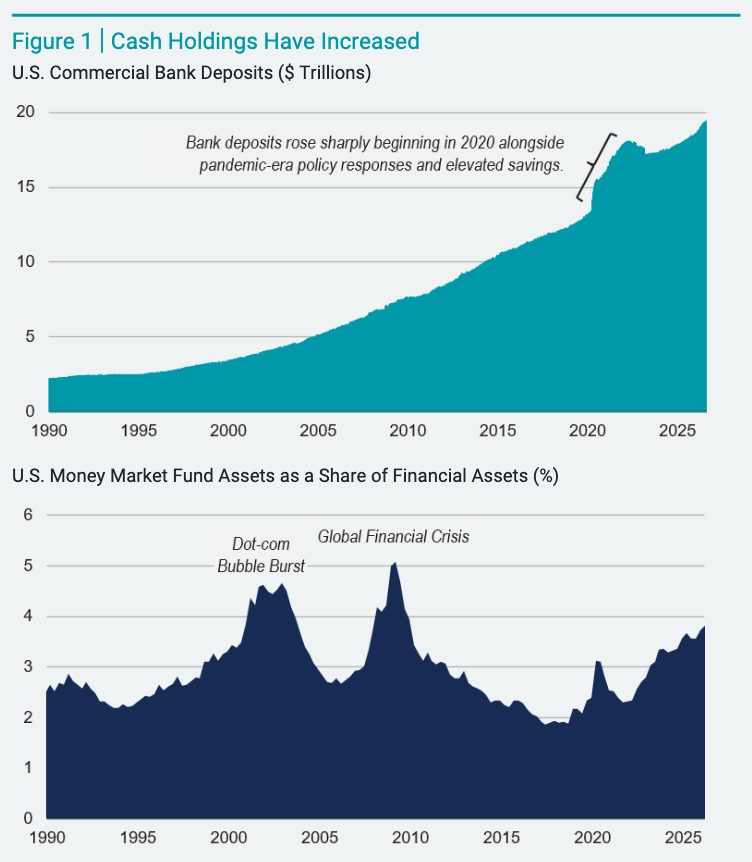
Cash balances have risen for many investors this year, whether measured by bank deposits or by money market funds as a share of assets, as shown in Figure 1. This has occurred amid heightened geopolitical tensions, including the war in Iran and the risk that it becomes a prolonged conflict. That possibility has renewed concerns about inflation, as the effects of the pandemic-era inflation spike remain fresh in investors’ minds. Adding to the uncertainty, opinions on how much artificial intelligence (AI) will reshape economies are as varied as those surrounding any previous technological revolution.

If volatility is a primary concern, the appeal of cash is understandable. Equities and higher-yielding bonds can experience meaningful drawdowns during periods of market stress, while cash yields are more attractive now than they have been for much of the past two decades.
But like much in investing, and frankly, in life, the decision comes with trade-offs. By allocating more to cash, investors reduce their exposure to assets that fluctuate more, which can help dampen portfolio volatility. At the same time, they reduce their exposure to assets that have historically generated higher long-term returns. In other words, raising cash levels in a portfolio doesn’t reduce the risk an investor faces. It simply changes it.
The consequences of holding too much cash often emerge gradually through inflation, lower long-term returns, or the possibility that assets fail to grow sufficiently to support future spending needs. These costs rarely arrive as a dramatic headline or a sudden market decline. Instead, they accumulate quietly over time. Yet over long investment horizons, they can be just as consequential, if not more so.
The Long-Term Cost of Safety
To explore this trade-off, consider a traditional portfolio of 70% global equities and 30% U.S. bonds, a risk profile common among U.S. investors. Since 1970, an investor in this portfolio would have accumulated approximately 26% more wealth than an investor who shifted 10% of the portfolio from equities to cash (60% equities, 30% bonds and 10% cash), as shown in Figure 2. The result illustrates how long investment horizons can amplify the effects of small differences in expected returns.
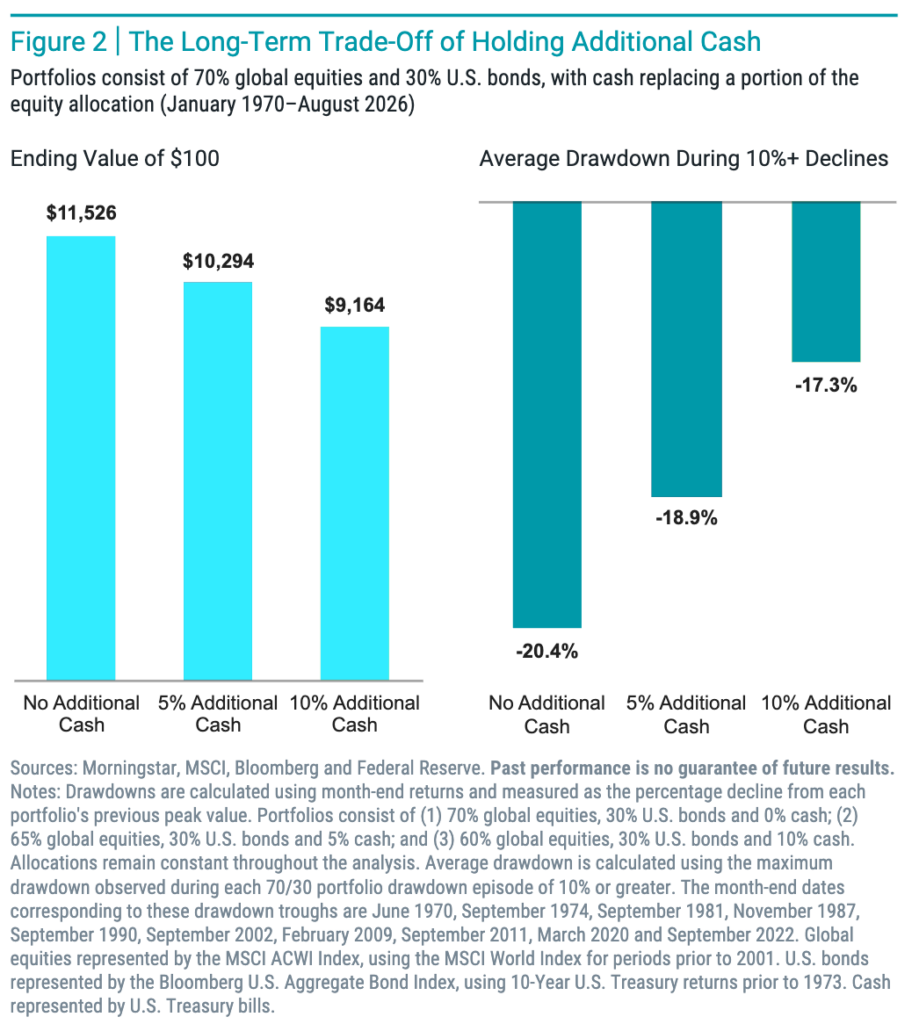
That higher ending wealth was accompanied by somewhat larger fluctuations in portfolio value. Over the full period, the 70/30 portfolio had an annualized standard deviation of 11%, compared with 9% for the portfolio with an additional 10% allocation to cash.
The difference was also evident during market declines. During the Global Financial Crisis, which represented the largest drawdown difference observed in the sample, the 70/30 portfolio’s maximum drawdown was approximately 5 percentage points higher than that of the portfolio with an additional 10% allocation to cash. Across all major drawdowns, the difference averaged approximately 3 percentage points.
The difference exists because cash and equities represent fundamentally different economic claims. Cash generally earns a short-term interest rate, while equities represent ownership in businesses whose earnings can grow over time.1 As those businesses reinvest, innovate and expand, investors participate in that growth through higher earnings, dividends and stock prices.
Over long periods, even modest differences in returns can lead to substantial differences in wealth because each year’s gains create a larger base on which future gains can compound. As a result, the performance gap between equities and cash tends to widen over time.
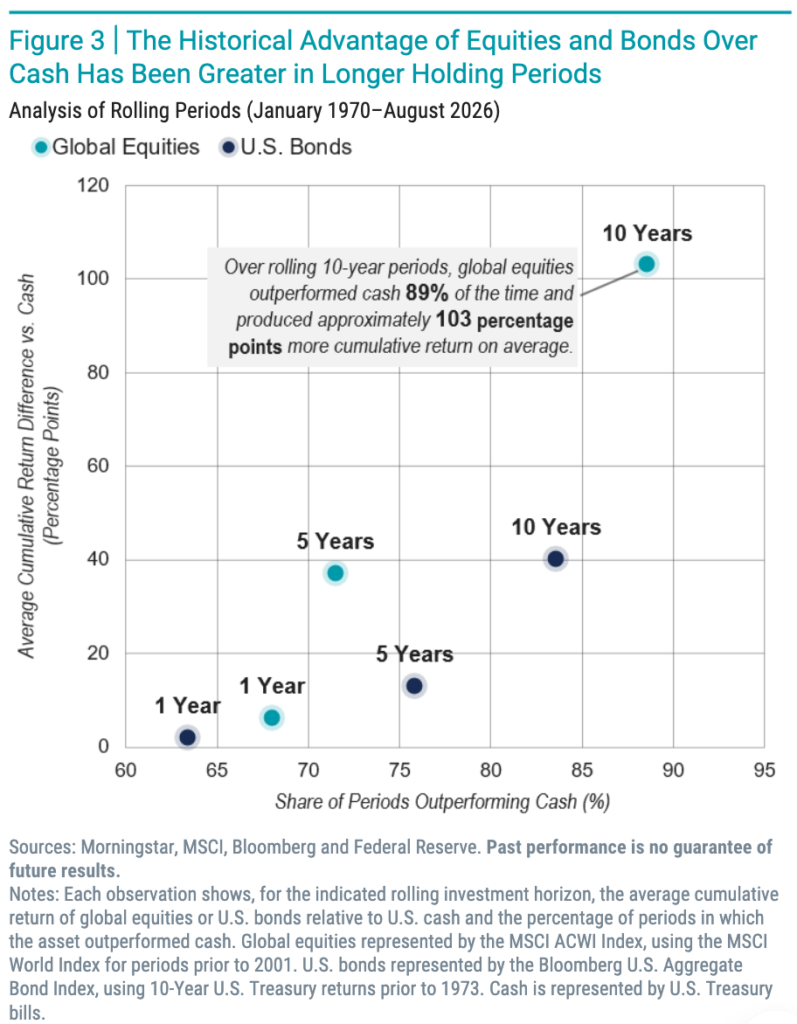
The historical record supports this idea. Over time, both equities and bonds have outperformed cash more often than not, even over relatively short investment horizons. As holding periods have lengthened, that advantage has generally become both more likely and more pronounced.
For instance, global equities outperformed cash in 68% of rolling one-year periods, 72% of rolling five-year periods and 89% of rolling 10-year periods,as shown in Figure 3. While the magnitude has varied across markets, currencies and time periods, the pattern itself has remained remarkably consistent.
If the historical evidence is so persistent, why do many investors continue to increase cash allocations during periods of uncertainty? Part of the answer is behavioral. Investors don’t experience all risks equally. A market decline is immediately visible. It appears on account statements, dominates financial headlines and often generates a strong emotional response.
By contrast, the costs of holding excess cash are rarely observed directly. Few investors receive a statement showing the wealth that could have been accumulated had a different allocation decision been made. As a result, the benefits of holding cash often feel tangible and immediate, while the associated costs remain abstract and deferred to the future.
This can make actions that reduce short-term anxiety seem prudent, even when they reduce the likelihood of achieving long-term goals. In fact, because many investors are uncomfortable with uncertainty, riskier assets have historically needed to offer higher expected returns to attract capital.
Putting Cash in Its Proper Place
None of this suggests that investors should avoid cash entirely. For near-term spending needs, such as an upcoming home purchase or other planned expenditures, keeping higher cash balances can be appropriate and prudent. Cash provides flexibility and can reduce the likelihood of being forced to sell long-term investments in unfavorable market conditions.
Determining how much cash to hold is an important part of financial planning. Advisors routinely help clients evaluate upcoming liabilities, liquidity needs, tax considerations and sources of future spending. In some cases, maintaining dedicated cash reserves may be appropriate. In others, future spending can be funded through ongoing portfolio management, such as rebalancing, tax-loss harvesting or selling appreciated assets as needed.
Investors are often tempted to increase cash balances when markets are at or near record highs. Yet such periods are a normal feature of long-term investing and, on their own, provide little guidance about future returns, as illustrated in Figure 4. As a result, future spending needs don’t always require maintaining large cash reserves years in advance.
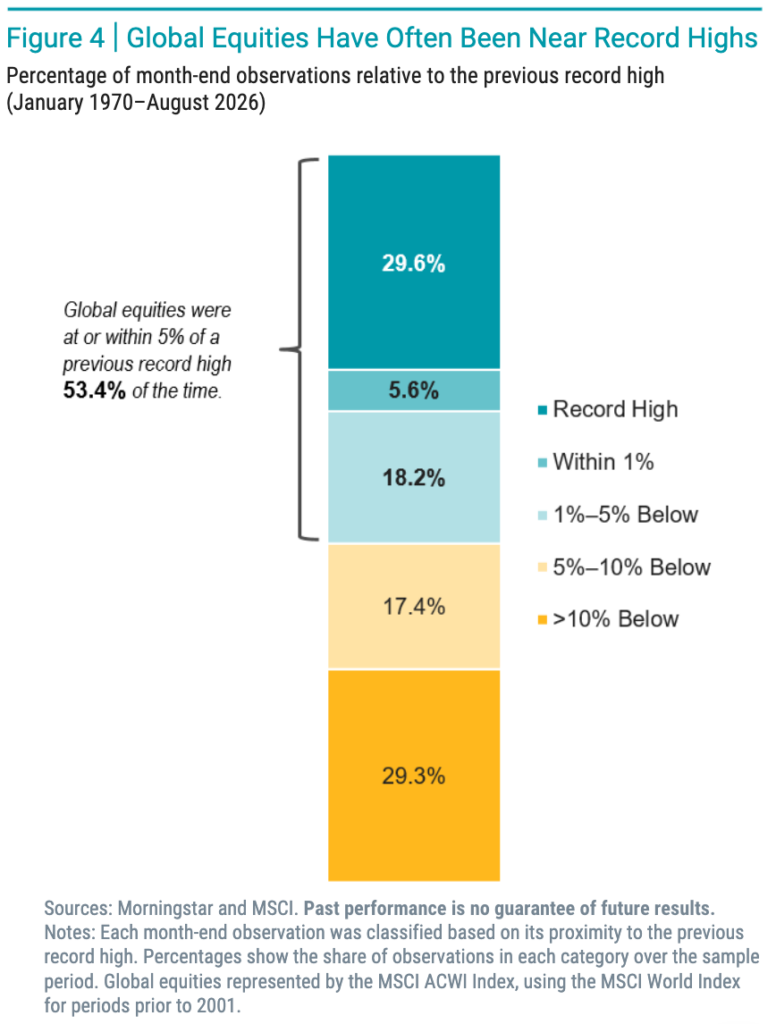
For investors waiting on the sidelines for “the right” buying opportunity, it’s worth remembering that history shows further gains have often followed all-time highs. In our view, the goal is neither to maximize nor minimize cash balances, but to align them with the purpose they are intended to serve.
Ultimately, the decision isn’t about avoiding risk but about choosing which risks to bear. In that sense, the greatest danger may not be market volatility itself but the sacrifice of long-term objectives in pursuit of short-term comfort.
If this article sparks questions, please feel free to contact us.
End Notes
- The term cash is used broadly to include bank deposits, money market funds, U.S. Treasury bills and other cash-equivalent investments.
Source: Avantis Investors is an investment advisor registered with the Securities and Exchange Commission.